Peak season rewards the facilities that prepare for it and punishes the ones that don’t. When order volume spikes during the holiday rush, produce season, or a promotional surge, the pressure lands squarely on your yard. Trailers arrive faster than they can be spotted, dock doors fill up, and a single staffing gap can ripple into hours of delay.
Keeping freight moving through those weeks is less about working harder and more about planning smarter, which is why a deliberate approach to peak season yard management separates facilities that keep flowing from those that grind to a halt. This guide breaks down how to staff your yard for peak so your operation stays fast, safe, and predictable.
| Peak Season Pressure | Understaffed In-House Yard | Dedicated Yard Staffing Partner |
|---|---|---|
| Trailer volume surge | Trailers wait to be spotted and docks stall | Trained spotters keep trailers moving on schedule |
| Seasonal hiring | Last-minute recruiting and high turnover | Pre-trained, retained crews ready before peak |
| Detention & demurrage | Fees pile up from slow trailer turns | Faster turn times protect against penalties |
| Coverage consistency | Gaps whenever staff call off | Reliable coverage every shift, all season |
Why Does Peak Season Put So Much Strain on Your Yard?
Peak season strains your yard because trailer volume climbs while your available labor stays flat or shrinks. A yard built to handle a few hundred moves a day can suddenly face a thousand, and every extra trailer must be checked in, spotted, tracked, and staged on a tighter clock.
At the same time, seasonal hiring competition makes qualified yard personnel harder to find and keep. The result is a bottleneck at the exact moment your customers expect flawless delivery. Congestion in the yard doesn’t stay in the yard, either: it backs up the docks, delays outbound loads, and drives up detention and demurrage costs.
What Happens When Your Yard Is Understaffed During Peak Season?
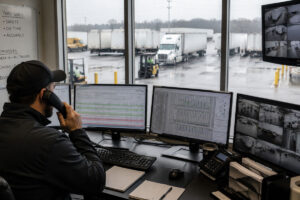
An understaffed yard during peak season quietly erodes every metric you care about. Trailers sit unspotted, drivers wait at the gate, and dock teams lose productive hours because the right trailer isn’t at the right door on time. Gaps like these are exactly what disciplined peak season yard management is built to prevent.
Missed appointments trigger detention charges, and rushed, fatigued crews make the kind of mistakes that create safety incidents around heavy equipment. Visibility suffers, too: when there aren’t enough hands to log moves and audit inventory, you lose track of what’s actually on your lot. The cost of being one or two people short isn’t linear; during peak, a small shortfall compounds shift after shift into missed shipments and frustrated customers.
How Do You Build a Peak Season Yard Staffing Plan That Works?
A resilient peak season yard management plan starts well before the first surge arrives. Begin by forecasting demand: pull last year’s volume data, layer in this year’s sales projections, and map the specific weeks when trailer counts will spike.
From there, build a staffing model with flex capacity so you can scale up quickly without overpaying during slower stretches. A few tactics consistently pay off:
– Cross-train your team so spotters, gate clerks, and shuttle drivers can cover multiple roles when volume shifts.
– Stage staffing to the surge, adding shifts during your busiest windows instead of spreading people thin all season.
– Standardize procedures for check-in, spotting, and dock assignments so new or temporary staff ramp up fast.
– Lean on your yard management system to prioritize moves and keep every shift working from the same real-time picture.
The goal is a plan that flexes with demand instead of breaking under it.
How Can a Dedicated Partner Keep Your Facility Moving?
A dedicated yard partner keeps your facility moving by supplying trained, reliable personnel and the oversight to deploy them well, with no last-minute hiring scramble. Building a seasonal workforce from scratch is difficult and expensive, especially when experienced yard talent is scarce. Partnering with a specialist in peak season yard management gives you seasoned spotters and supervisors who already know how to run high-volume, multi-building operations.
Nolan Logistics has done exactly this for some of the nation’s most demanding facilities since 1982, focusing on staffing stability, continuous training, and workflows tailored to each site. Because the team works within your existing yard management system and site-specific safety standards, coverage stays consistent from the first peak shift to the last, so your yard keeps flowing when it matters most.
Frequently Asked Questions
When should I start planning for peak season yard staffing?
Start at least two to three months before your expected surge. Early planning gives you time to forecast volume, secure trained personnel, cross-train your existing team, and refine procedures before the pressure hits, rather than scrambling once trailers are already stacking up.
How many extra yard staff do I need for peak season?
It depends on your projected trailer volume, yard size, and shift structure. The most reliable method is to base headcount on historical peak data and current sales forecasts. A yard partner can help you model the right number so you add enough coverage for your busiest windows without overstaffing slower stretches.
What’s the difference between yard staffing and full yard management?
Yard staffing supplies the personnel to move and track trailers. Full yard management adds supervision, standardized processes, reporting, and technology integration on top of that labor, keeping your yard running as a coordinated system rather than just a set of filled shifts.
Can outsourced yard staff work with our existing systems?
Yes. A capable yard management provider works within your current yard management system and follows your site-specific safety and operating procedures, so you gain added capacity without disrupting the workflows your team already relies on.
Ready to keep your yard moving this peak season? Nolan Logistics delivers reliable yard management, trailer spotting, and shuttle services built for high-volume facilities across the Midwest and eastern states. Request an estimate through the Nolan Logistics contact page, or call (812) 282-7556 to talk through your peak season plan. Nolan Logistics is located at 131 E Court Ave #200, Jeffersonville, IN 47130.